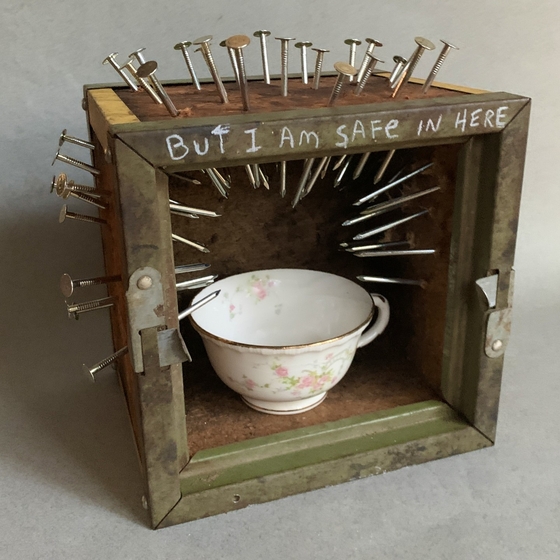
No Explosions by Naomi Shihab Nye To enjoy fireworks you would have to have lived a different kind of life.
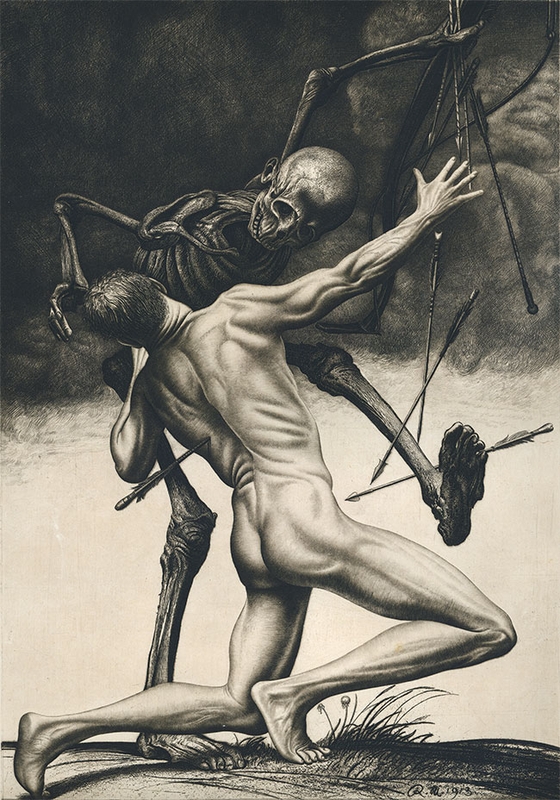
Nothing But Death by Pablo Neruda There are cemeteries that are lonely, graves full of bones that do not make a sound, the heart moving through a tunnel, in it darkness, darkness, darkness, like a shipwreck we die going into ourselves, as though we were drowning inside our hearts, as though we lived falling out of the skin into the soul. And there are corpses, feet made of cold and sticky clay, death is inside the bones, like a barking where there are no dogs, coming out from bells somewhere, from graves somewhere, growing in the damp air like tears of rain. Sometimes I see alone coffins under sail, embarking with the pale dead, with women that have dead hair, with bakers who are as white as angels, and pensive young girls married to notary publics, caskets sailing up the vertical river of the dead, the river of dark purple, moving upstream with sails filled out by the sound of death, filled by the sound of death which is silence. Death arrives among all that sound like a shoe with no foot in it, like a suit with no man in it, comes and knocks, using a ring with no stone in it, with no finger in it, comes and shouts with no mouth, with no tongue, with no throat. Nevertheless its steps can be heard and its clothing makes a hushed sound, like a tree. I'm not sure, I understand only a little, I can hardly see, but it seems to me that its singing has the color of damp violets, of violets that are at home in the earth, because the face of death is green, and the look death gives is green, with the penetrating dampness of a violet leaf and the somber color of embittered winter. But death also goes through the world dressed as a broom, lapping the floor, looking for dead bodies, death is inside the broom, the broom is the tongue of death looking for corpses, it is the needle of death looking for thread. Death is inside the folding cots: it spends its life sleeping on the slow mattresses, in the black blankets, and suddenly breathes out: it blows out a mournful sound that swells the sheets, and the beds go sailing toward a port where death is waiting, dressed like an admiral.
Excerpt from “Walden: Where I Lived and What I Lived For” by Henry David Thoreau
We must learn to reawaken and keep ourselves awake, not by mechanical aids, but by an infinite expectation of the dawn, which does not forsake us in our soundest sleep. I know of no more encouraging fact than the unquestionable ability of man to elevate his life by a conscious endeavor. It is something to be able to paint a particular picture, or to carve a statue, and so to make a few objects beautiful; but it is far more glorious to carve and paint the very atmosphere and medium through which we look, which morally we can do. To affect the quality of the day, that is the highest of arts. Every man is tasked to make his life, even in its details, worthy of the contemplation of his most elevated and critical hour. If we refused, or rather used up, such paltry information as we get, the oracles would distinctly inform us how this might be done.
I went to the woods because I wished to live deliberately, to front only the essential facts of life, and see if I could not learn what it had to teach, and not, when I came to die, discover that I had not lived. I did not wish to live what was not life, living is so dear; nor did I wish to practice resignation, unless it was quite necessary. I wanted to live deep and suck out all the marrow of life, to live so sturdily and Spartan-like as to put to rout all that was not life, to cut a broad swath and shave close, to drive life into a corner, and reduce it to its lowest terms, and, if it proved to be mean, why then to get the whole and genuine meanness of it, and publish its meanness to the world; or if it were sublime, to know it by experience, and be able to give a true account of it in my next excursion. For most men, it appears to me, are in a strange uncertainty about it, whether it is of the devil or of God, and have somewhat hastily concluded that it is the chief end of man here to “glorify God and enjoy him forever.”
Still, we live meanly, like ants; though the fable tells us that we were long ago changed into men; like pygmies, we fight with cranes; it is error upon error, and clout upon clout, and our best virtue has for its occasion a superfluous and evitable wretchedness. Our life is frittered away by detail. An honest man has hardly need to count more than his ten fingers, or in extreme cases he may add his ten toes, and lump the rest. Simplicity, simplicity, simplicity! I say, let your affairs be as two or three, and not a hundred or a thousand; instead of a million count half a dozen, and keep your accounts on your thumb nail. In the midst of this chopping sea of civilized life, such are the clouds and storms and quicksands and thousand-and-one items to be allowed for, that a man has to live, if he would not founder and go to the bottom and not make his port at all, by dead reckoning, and he must be a great calculator indeed who succeeds. Simplify, simplify.
Gaudeamus Igitur Gaudeamus igitur, Iuvenes dum sumus; Post iucundam iuventutem, Post molestam senectutem, Nos habebit humus, Nos habebit humus. Ubi sunt, qui ante nos In mundo fuere? Vadite ad superos, Transite ad inferos, Ubi iam fuere, Ubi iam fuere. Vita nostra brevis est, Brevi finietur; Venit mors velociter, Rapit nos atrociter; Nemini parcetur, Nemini parcetur. Vivat academia, Vivant professores, Vivat membrum quodlibet, Vivant membra quae libet; Semper sint in flore, Semper sint in flore. Vivat et respublica, Et qui illam regit, Vivat nostra civitas, Maecenatum caritas, Quae nos hic protegit, Quae nos hic protegit. Vivant omnes virgines, Faciles, formosae, Vivant et mulieres, Tenerae, amabiles, Bonae, laboriosae, Bonae, laboriosae. Pereat tristitia, Pereant osores, Pereat diabolus, Quivis antiburschius, Atque irrisores, Atque irrisores.
True Love by Barry Gifford
Your sickness made me
a little sick, it's
true—I still
feel it
Mayakovsky got down
on his knees
and declared
his love
to his last
mistress
a few hours after
he'd met her
Remember me
at the hotel
in Paris,
on my knees
in the lift?
We're all the same
men of too much passion
and a little talent—
some a little more
than others
We fool ourselves
into thinking
we're strong
then complain
the rest of our lives
crippled by
the consequences
Last Night's Dream by Barry Gifford
In last night's dream I went back to see
you
I found you on a bad street in Mexico
City
working as a prostitute
You didn't want me to look at you
You'd lost your job, had no money
Come with me, I said, I'll take care of you
You wouldn't let me touch you
No, you said, it won't be any use,
and anyway, you know I'm dead
I hung around out of sight and watched
you
solicit strangers on the street,
men walking, men in cars
You came around a corner and spotted
me
Leave me alone you said, it's too late
You still looked good, your hair was
clean
and black but a couple of your teeth were
missing
and your clothes were soiled
You walked quickly toward another
street
Don't follow me, you shouted
I remembered that you had a photo
graph
of me on a wall in your house,
one I'd never seen before
I asked you where it was from,
who'd taken it, where you'd gotten it
I made it, you said, out of photographs
of other people, it was difficult
and it took me a very long time
Love Is Not All by Edna St. Vincent Millay Love is not all: it is not meat nor drink Nor slumber nor a roof against the rain; Nor yet a floating spar to men that sink And rise and sink and rise and sink again; Love can not fill the thickened lung with breath, Nor clean the blood, nor set the fractured bone; Yet many a man is making friends with death Even as I speak, for lack of love alone. It well may be that in a difficult hour, Pinned down by pain and moaning for release, Or nagged by want past resolution's power, I might be driven to sell your love for peace, Or trade the memory of this night for food. It well may be. I do not think I would.
Simple by Raymond Carver A break in the clouds. The blue outline of the mountains. Dark yellow of the fields. Black river. What am I doing here, lonely and filled with remorse? I go on casually eating from the bowl of raspberries. If I were dead, I remind myself, I wouldn’t be eating them. It’s not so simple. It is that simple.
NO SUCH THING AS THE INNOCENT BYSTANDER by Andrea Gibson Silence rides shotgun wherever hate goes.
The Kitten by Mary Oliver More amazed than anything I took the perfectly black stillborn kitten with the one large eye in the center of its small forehead from the house cat's bed and buried it in a field behind the house. I suppose I could have given it to a museum, I could have called the local newspaper. But instead I took it out into the field and opened the earth and put it back saying, it was real, saying, life is infinitely inventive, saying, what other amazements lie in the dark seed of the earth, yes, I think I did right to go out alone and give it back peacefully, and cover the place with the reckless blossoms of weeds.