The Waste Land By T. S. Eliot

“Nam Sibyllam quidem Cumis ego ipse oculis meis vidi
in ampulla pendere, et cum illi pueri dicerent: Σιβυλλα
τι θελεις; respondebat illa: αποθανειν θελω.”

                        For Ezra Pound
                        il miglior fabbro

              I. THE BURIAL OF THE DEAD

APRIL is the cruellest month, breeding	 
Lilacs out of the dead land, mixing	 
Memory and desire, stirring	 
Dull roots with spring rain.	 
Winter kept us warm, covering
Earth in forgetful snow, feeding	 
A little life with dried tubers.	 
Summer surprised us, coming over the Starnbergersee	 
With a shower of rain; we stopped in the colonnade,	 
And went on in sunlight, into the Hofgarten,
And drank coffee, and talked for an hour.	 
Bin gar keine Russin, stamm’ aus Litauen, echt deutsch.	 
And when we were children, staying at the archduke’s,	 
My cousin’s, he took me out on a sled,	 
And I was frightened. He said, Marie,
Marie, hold on tight. And down we went.	 
In the mountains, there you feel free.	 
I read, much of the night, and go south in the winter.	 
 
What are the roots that clutch, what branches grow	 
Out of this stony rubbish? Son of man,
You cannot say, or guess, for you know only	 
A heap of broken images, where the sun beats,	 
And the dead tree gives no shelter, the cricket no relief,	 
And the dry stone no sound of water. Only	 
There is shadow under this red rock,
(Come in under the shadow of this red rock),	 
And I will show you something different from either	 
Your shadow at morning striding behind you	 
Or your shadow at evening rising to meet you;	 
I will show you fear in a handful of dust.	
        Frisch weht der Wind	 
        Der Heimat zu,	 
        Mein Irisch Kind,	 
        Wo weilest du?	 
“You gave me hyacinths first a year ago;
They called me the hyacinth girl.”	 
—Yet when we came back, late, from the Hyacinth garden,	 
Your arms full, and your hair wet, I could not	 
Speak, and my eyes failed, I was neither	 
Living nor dead, and I knew nothing,
Looking into the heart of light, the silence.	 
Öd’ und leer das Meer.	 
 
Madame Sosostris, famous clairvoyante,	 
Had a bad cold, nevertheless	 
Is known to be the wisest woman in Europe,
With a wicked pack of cards. Here, said she,	 
Is your card, the drowned Phoenician Sailor,	 
(Those are pearls that were his eyes. Look!)	 
Here is Belladonna, the Lady of the Rocks,	 
The lady of situations.
Here is the man with three staves, and here the Wheel,	 
And here is the one-eyed merchant, and this card,	 
Which is blank, is something he carries on his back,	 
Which I am forbidden to see. I do not find	 
The Hanged Man. Fear death by water.
I see crowds of people, walking round in a ring.	 
Thank you. If you see dear Mrs. Equitone,	 
Tell her I bring the horoscope myself:	 
One must be so careful these days.	 
 
Unreal City,
Under the brown fog of a winter dawn,	 
A crowd flowed over London Bridge, so many,	 
I had not thought death had undone so many.	 
Sighs, short and infrequent, were exhaled,	 
And each man fixed his eyes before his feet.
Flowed up the hill and down King William Street,	 
To where Saint Mary Woolnoth kept the hours	 
With a dead sound on the final stroke of nine.	 
There I saw one I knew, and stopped him, crying “Stetson!	 
You who were with me in the ships at Mylae!
That corpse you planted last year in your garden,	 
Has it begun to sprout? Will it bloom this year?	 
Or has the sudden frost disturbed its bed?	 
Oh keep the Dog far hence, that’s friend to men,	 
Or with his nails he’ll dig it up again!
You! hypocrite lecteur!—mon semblable,—mon frère!”	 
 
II. A GAME OF CHESS

The Chair she sat in, like a burnished throne,	 
Glowed on the marble, where the glass	 
Held up by standards wrought with fruited vines	 
From which a golden Cupidon peeped out
(Another hid his eyes behind his wing)	 
Doubled the flames of sevenbranched candelabra	 
Reflecting light upon the table as	 
The glitter of her jewels rose to meet it,	 
From satin cases poured in rich profusion;
In vials of ivory and coloured glass	 
Unstoppered, lurked her strange synthetic perfumes,	 
Unguent, powdered, or liquid—troubled, confused	 
And drowned the sense in odours; stirred by the air	 
That freshened from the window, these ascended
In fattening the prolonged candle-flames,	 
Flung their smoke into the laquearia,	 
Stirring the pattern on the coffered ceiling.	 
Huge sea-wood fed with copper	 
Burned green and orange, framed by the coloured stone,
In which sad light a carvèd dolphin swam.	 
Above the antique mantel was displayed	 
As though a window gave upon the sylvan scene	 
The change of Philomel, by the barbarous king	 
So rudely forced; yet there the nightingale
Filled all the desert with inviolable voice	 
And still she cried, and still the world pursues,	 
“Jug Jug” to dirty ears.	 
And other withered stumps of time	 
Were told upon the walls; staring forms
Leaned out, leaning, hushing the room enclosed.	 
Footsteps shuffled on the stair,	 
Under the firelight, under the brush, her hair	 
Spread out in fiery points	 
Glowed into words, then would be savagely still.
 
“My nerves are bad to-night. Yes, bad. Stay with me.	 
Speak to me. Why do you never speak? Speak.	 
What are you thinking of? What thinking? What?	 
I never know what you are thinking. Think.”	 
 
I think we are in rats’ alley
Where the dead men lost their bones.	 
 
“What is that noise?”	 
                      The wind under the door.	 
“What is that noise now? What is the wind doing?”	 
                      Nothing again nothing.
                                              “Do	 
You know nothing? Do you see nothing? Do you remember	 
Nothing?”	 
        I remember	 
                Those are pearls that were his eyes.
“Are you alive, or not? Is there nothing in your head?”	 
                                                         But	 
O O O O that Shakespeherian Rag—	 
It’s so elegant	 
So intelligent
 
“What shall I do now? What shall I do?	 
I shall rush out as I am, and walk the street	 
With my hair down, so. What shall we do to-morrow?	 
What shall we ever do?”	 
                          The hot water at ten.
And if it rains, a closed car at four.	 
And we shall play a game of chess,	 
Pressing lidless eyes and waiting for a knock upon the door.	 
 
When Lil’s husband got demobbed, I said,	 
I didn’t mince my words, I said to her myself,	
HURRY UP PLEASE ITS TIME	 
Now Albert’s coming back, make yourself a bit smart.	 
He’ll want to know what you done with that money he gave you	 
To get yourself some teeth. He did, I was there.	 
You have them all out, Lil, and get a nice set,	
He said, I swear, I can’t bear to look at you.	 
And no more can’t I, I said, and think of poor Albert,	 
He’s been in the army four years, he wants a good time,	 
And if you don’t give it him, there’s others will, I said.	 
Oh is there, she said. Something o’ that, I said.
Then I’ll know who to thank, she said, and give me a straight look.	 
HURRY UP PLEASE ITS TIME	 
If you don’t like it you can get on with it, I said,	 
Others can pick and choose if you can’t.	 
But if Albert makes off, it won’t be for lack of telling.
You ought to be ashamed, I said, to look so antique.	 
(And her only thirty-one.)	 
I can’t help it, she said, pulling a long face,	 
It’s them pills I took, to bring it off, she said.	 
(She’s had five already, and nearly died of young George.)
The chemist said it would be alright, but I’ve never been the same.	 
You are a proper fool, I said.	 
Well, if Albert won’t leave you alone, there it is, I said,	 
What you get married for if you don’t want children?	 
HURRY UP PLEASE ITS TIME
Well, that Sunday Albert was home, they had a hot gammon,	 
And they asked me in to dinner, to get the beauty of it hot—	 
HURRY UP PLEASE ITS TIME	 
Goonight Bill. Goonight Lou. Goonight May. Goonight.
Ta ta. Goonight. Goonight.	 
Good night, ladies, good night, sweet ladies, good night, good night.	 
 
III. THE FIRE SERMON

The river’s tent is broken: the last fingers of leaf	 
Clutch and sink into the wet bank. The wind	 
Crosses the brown land, unheard. The nymphs are departed.
Sweet Thames, run softly, till I end my song.	 
The river bears no empty bottles, sandwich papers,	 
Silk handkerchiefs, cardboard boxes, cigarette ends	 
Or other testimony of summer nights. The nymphs are departed.	 
And their friends, the loitering heirs of city directors;
Departed, have left no addresses.	 
By the waters of Leman I sat down and wept…	 
Sweet Thames, run softly till I end my song,	 
Sweet Thames, run softly, for I speak not loud or long.	 
But at my back in a cold blast I hear
The rattle of the bones, and chuckle spread from ear to ear.	 
 
A rat crept softly through the vegetation	 
Dragging its slimy belly on the bank	 
While I was fishing in the dull canal	 
On a winter evening round behind the gashouse.
Musing upon the king my brother’s wreck	 
And on the king my father’s death before him.	 
White bodies naked on the low damp ground	 
And bones cast in a little low dry garret,	 
Rattled by the rat’s foot only, year to year.
But at my back from time to time I hear	 
The sound of horns and motors, which shall bring	 
Sweeney to Mrs. Porter in the spring.	 
O the moon shone bright on Mrs. Porter	 
And on her daughter
They wash their feet in soda water	 
Et, O ces voix d’enfants, chantant dans la coupole!	 
 
Twit twit twit	 
Jug jug jug jug jug jug	 
So rudely forc’d.
Tereu	 
 
Unreal City	 
Under the brown fog of a winter noon	 
Mr Eugenides, the Smyrna merchant	 
Unshaven, with a pocket full of currants	
C. i. f. London: documents at sight,	 
Asked me in demotic French	 
To luncheon at the Cannon Street Hotel	 
Followed by a week-end at the Metropole.	 
 
At the violet hour, when the eyes and back
Turn upward from the desk, when the human engine waits	 
Like a taxi throbbing waiting,	 
I Tiresias, though blind, throbbing between two lives,	 
Old man with wrinkled female breasts, can see	 
At the violet hour, the evening hour that strives
Homeward, and brings the sailor home from sea,	 
The typist home at tea-time, clears her breakfast, lights	 
Her stove, and lays out food in tins.	 
Out of the window perilously spread	 
Her drying combinations touched by the sun’s last rays,
On the divan are piled (at night her bed)	 
Stockings, slippers, camisoles, and stays.	 
I Tiresias, old man with wrinkled dugs	 
Perceived the scene, and foretold the rest—	 
I too awaited the expected guest.
He, the young man carbuncular, arrives,	 
A small house-agent’s clerk, with one bold stare,	 
One of the low on whom assurance sits	 
As a silk hat on a Bradford millionaire.	 
The time is now propitious, as he guesses,
The meal is ended, she is bored and tired,	 
Endeavours to engage her in caresses	 
Which still are unreproved, if undesired.	 
Flushed and decided, he assaults at once;	 
Exploring hands encounter no defence;
His vanity requires no response,	 
And makes a welcome of indifference.	 
(And I Tiresias have foresuffered all	 
Enacted on this same divan or bed;	 
I who have sat by Thebes below the wall
And walked among the lowest of the dead.)	 
Bestows one final patronizing kiss,	 
And gropes his way, finding the stairs unlit…	 
 
She turns and looks a moment in the glass,	 
Hardly aware of her departed lover;
Her brain allows one half-formed thought to pass:	 
“Well now that’s done: and I’m glad it’s over.”	 
When lovely woman stoops to folly and	 
Paces about her room again, alone,	 
She smoothes her hair with automatic hand,
And puts a record on the gramophone.	 
 
“This music crept by me upon the waters”	 
And along the Strand, up Queen Victoria Street.	 
O City City, I can sometimes hear	 
Beside a public bar in Lower Thames Street,
The pleasant whining of a mandoline	 
And a clatter and a chatter from within	 
Where fishmen lounge at noon: where the walls	 
Of Magnus Martyr hold	 
Inexplicable splendour of Ionian white and gold.
 
The river sweats	 
Oil and tar	 
The barges drift	 
With the turning tide	 
Red sails
Wide	 
To leeward, swing on the heavy spar.	 
The barges wash	 
Drifting logs	 
Down Greenwich reach
Past the Isle of Dogs.	 
            Weialala leia	 
            Wallala leialala	 
Elizabeth and Leicester	 
Beating oars
The stern was formed	 
A gilded shell	 
Red and gold	 
The brisk swell	 
Rippled both shores
South-west wind	 
Carried down stream	 
The peal of bells	 
White towers	 
            Weialala leia
            Wallala leialala	 
 
“Trams and dusty trees.	 
Highbury bore me. Richmond and Kew	 
Undid me. By Richmond I raised my knees	 
Supine on the floor of a narrow canoe.“
 
“My feet are at Moorgate, and my heart	 
Under my feet. After the event	 
He wept. He promised ‘a new start.’	 
I made no comment. What should I resent?”	 
 
“On Margate Sands.
I can connect	 
Nothing with nothing.	 
The broken finger-nails of dirty hands.	 
My people humble people who expect	 
Nothing.”
 
      la la	 
 
To Carthage then I came	 
 
Burning burning burning burning	 
O Lord Thou pluckest me out	 
O Lord Thou pluckest
 
burning	 
 
IV. DEATH BY WATER

Phlebas the Phoenician, a fortnight dead,	 
Forgot the cry of gulls, and the deep seas swell	 
And the profit and loss.	 
                          A current under sea
Picked his bones in whispers. As he rose and fell	 
He passed the stages of his age and youth	 
Entering the whirlpool.	 
                          Gentile or Jew	 
O you who turn the wheel and look to windward,
Consider Phlebas, who was once handsome and tall as you.	 
 
V. WHAT THE THUNDER SAID

After the torch-light red on sweaty faces	 
After the frosty silence in the gardens	 
After the agony in stony places	 
The shouting and the crying
Prison and place and reverberation	 
Of thunder of spring over distant mountains	 
He who was living is now dead	 
We who were living are now dying	 
With a little patience
 
Here is no water but only rock	 
Rock and no water and the sandy road	 
The road winding above among the mountains	 
Which are mountains of rock without water	 
If there were water we should stop and drink
Amongst the rock one cannot stop or think	 
Sweat is dry and feet are in the sand	 
If there were only water amongst the rock	 
Dead mountain mouth of carious teeth that cannot spit	 
Here one can neither stand nor lie nor sit
There is not even silence in the mountains	 
But dry sterile thunder without rain	 
There is not even solitude in the mountains	 
But red sullen faces sneer and snarl	 
From doors of mud-cracked houses
                                If there were water
And no rock	 
If there were rock	 
And also water	 
And water	 
A spring
A pool among the rock	 
If there were the sound of water only	 
Not the cicada	 
And dry grass singing	 
But sound of water over a rock
Where the hermit-thrush sings in the pine trees	 
Drip drop drip drop drop drop drop	 
But there is no water	 
 
Who is the third who walks always beside you?	 
When I count, there are only you and I together
But when I look ahead up the white road	 
There is always another one walking beside you	 
Gliding wrapt in a brown mantle, hooded	 
I do not know whether a man or a woman	 
—But who is that on the other side of you?
 
What is that sound high in the air	 
Murmur of maternal lamentation	 
Who are those hooded hordes swarming	 
Over endless plains, stumbling in cracked earth	 
Ringed by the flat horizon only
What is the city over the mountains	 
Cracks and reforms and bursts in the violet air	 
Falling towers	 
Jerusalem Athens Alexandria	 
Vienna London
Unreal	 
 
A woman drew her long black hair out tight	 
And fiddled whisper music on those strings	 
And bats with baby faces in the violet light	 
Whistled, and beat their wings
And crawled head downward down a blackened wall	 
And upside down in air were towers	 
Tolling reminiscent bells, that kept the hours	 
And voices singing out of empty cisterns and exhausted wells.	 
 
In this decayed hole among the mountains
In the faint moonlight, the grass is singing	 
Over the tumbled graves, about the chapel	 
There is the empty chapel, only the wind’s home.	 
It has no windows, and the door swings,	 
Dry bones can harm no one.
Only a cock stood on the roof-tree	 
Co co rico co co rico	 
In a flash of lightning. Then a damp gust	 
Bringing rain	 
Ganga was sunken, and the limp leaves	
Waited for rain, while the black clouds	 
Gathered far distant, over Himavant.	 
The jungle crouched, humped in silence.	 
Then spoke the thunder	 
DA
Datta: what have we given?	 
My friend, blood shaking my heart	 
The awful daring of a moment’s surrender	 
Which an age of prudence can never retract	 
By this, and this only, we have existed
Which is not to be found in our obituaries	 
Or in memories draped by the beneficent spider	 
Or under seals broken by the lean solicitor	 
In our empty rooms	 
DA
Dayadhvam: I have heard the key	 
Turn in the door once and turn once only	 
We think of the key, each in his prison	 
Thinking of the key, each confirms a prison	 
Only at nightfall, aetherial rumours
Revive for a moment a broken Coriolanus	 
DA	 
Damyata: The boat responded	 
Gaily, to the hand expert with sail and oar	 
The sea was calm, your heart would have responded
Gaily, when invited, beating obedient	 
To controlling hands	 
 
                      I sat upon the shore	 
Fishing, with the arid plain behind me	 
Shall I at least set my lands in order?
 
London Bridge is falling down falling down falling down	 
 
Poi s’ascose nel foco che gli affina	 
Quando fiam ceu chelidon—O swallow swallow	 
Le Prince d’Aquitaine à la tour abolie	 
These fragments I have shored against my ruins
Why then Ile fit you. Hieronymo’s mad againe.	 
Datta. Dayadhvam. Damyata.	 
 
      Shantih    shantih    shantih


Home | Link
Monday | 8 August 2016 | 12:35 PM

 The Mask of Anarchy by Percy Bysshe Shelley

I

As I lay asleep in Italy
There came a voice from over the Sea
And with great power it forth led me
To walk in the visions of Poesy.

II

I met Murder on the way -
He had a mask like Castlereagh -
Very smooth he looked, yet grim;
Seven blood-hounds followed him:

III

All were fat; and well they might
Be in admirable plight,
For one by one, and two by two,
He tossed the human hearts to chew
Which from his wide cloak he drew.

IV

Next came Fraud, and he had on,
Like Eldon, an ermined gown;
His big tears, for he wept well,
Turned to mill-stones as they fell.

V

And the little children, who
Round his feet played to and fro,
Thinking every tear a gem,
Had their brains knocked out by them.

VI

Clothed with the Bible, as with light,
And the shadows of the night,
Like Sidmouth, next, Hypocrisy
On a crocodile rode by.

VII

And many more Destructions played
In this ghastly masquerade,
All disguised, even to the eyes,
Like Bishops, lawyers, peers, or spies.

VIII

Last came Anarchy: he rode
On a white horse, splashed with blood;
He was pale even to the lips,
Like Death in the Apocalypse.

IX

And he wore a kingly crown;
And in his grasp a sceptre shone;
On his brow this mark I saw -
'I AM GOD, AND KING, AND LAW!'

X

With a pace stately and fast,
Over English land he passed,
Trampling to a mire of blood
The adoring multitude,

XI

And a mighty troop around,
With their trampling shook the ground,
Waving each a bloody sword,
For the service of their Lord.

XII

And with glorious triumph, they
Rode through England proud and gay,
Drunk as with intoxication
Of the wine of desolation.

XIII

O'er fields and towns, from sea to sea,
Passed the Pageant swift and free,
Tearing up, and trampling down;
Till they came to London town.

XIV

And each dweller, panic-stricken,
Felt his heart with terror sicken
Hearing the tempestuous cry
Of the triumph of Anarchy.

XV

For with pomp to meet him came,
Clothed in arms like blood and flame,
The hired murderers, who did sing
'Thou art God, and Law, and King.

XVI

'We have waited, weak and lone
For thy coming, Mighty One!
Our purses are empty, our swords are cold,
Give us glory, and blood, and gold.'

XVII

Lawyers and priests, a motley crowd,
To the earth their pale brows bowed;
Like a bad prayer not over loud
Whispering - 'Thou art Law and God.' -

XVIII

Then all cried with one accord,
'Thou art King, and God and Lord;
Anarchy, to thee we bow,
Be thy name made holy now!'

XIX

And Anarchy, the Skeleton,
Bowed and grinned to every one,
As well as if his education
Had cost ten millions to the nation.

XX

For he knew the Palaces
Of our Kings were rightly his;
His the sceptre, crown and globe,
And the gold-inwoven robe.

XXI

So he sent his slaves before
To seize upon the Bank and Tower,
And was proceeding with intent
To meet his pensioned Parliament

XXII

When one fled past, a maniac maid,
And her name was Hope, she said:
But she looked more like Despair,
And she cried out in the air:

XXIII

'My father Time is weak and gray
With waiting for a better day;
See how idiot-like he stands,
Fumbling with his palsied hands!

XXIV

‘He has had child after child,
And the dust of death is piled
Over every one but me -
Misery, oh, Misery!'

XXV

Then she lay down in the street,
Right before the horses' feet,
Expecting, with a patient eye,
Murder, Fraud, and Anarchy.

XXVI

When between her and her foes
A mist, a light, an image rose,
Small at first, and weak and frail
Like the vapour of a vale:

XXVII

Till as clouds grow on the blast,
Like tower-crowned giants striding fast,
And glare with lightnings as they fly,
And speak in thunder to the sky

XXVIII

It grew - a Shape arrayed in mail
Brighter than the viper's scale,
And upborne on wings whose grain
Was as the light of sunny rain.

XXIX

On its helm, seen far away,
A planet, like the Morning's, lay;
And those plumes its light rained through
Like a shower of crimson dew.

XXX

With step as soft as wind it passed,
O'er the heads of men - so fast
That they knew the presence there,
And looked, - but all was empty air.

XXXI

As flowers beneath May's footstep waken,
As stars from Night's loose hair are shaken,
As waves arise when loud winds call,
Thoughts sprung where'er that step did fall.

XXXII

And the prostrate multitude
Looked - and ankle-deep in blood,
Hope, that maiden most serene,
Was walking with a quiet mien:

XXXIII

And Anarchy, the ghastly birth,
Lay dead earth upon the earth;
The Horse of Death tameless as wind
Fled, and with his hoofs did grind
To dust the murderers thronged behind.

XXXIV

A rushing light of clouds and splendour,
A sense awakening and yet tender
Was heard and felt - and at its close
These words of joy and fear arose

XXXV

As if their own indignant Earth
Which gave the sons of England birth
Had felt their blood upon her brow,
And shuddering with a mother's throe

XXXVI

Had turnèd every drop of blood
By which her face had been bedewed
To an accent unwithstood, -
As if her heart had cried aloud:

XXXVII

'Men of England, heirs of Glory,
Heroes of unwritten story,
Nurslings of one mighty Mother,
Hopes of her, and one another;

XXXVIII

'Rise like Lions after slumber
In unvanquishable number,
Shake your chains to earth like dew
Which in sleep had fallen on you -
Ye are many - they are few.’


Home | Link
Saturday | 16 July 2016 | 01:09 PM

As I Walked Out One Evening by W. H. Auden

As I walked out one evening,
  Walking down Bristol Street,
The crowds upon the pavement
  Were fields of harvest wheat.

And down by the brimming river
  I heard a lover sing
Under an arch of the railway:
  "Love has no ending.

"I'll love you, dear, I'll love you
  Till China and Africa meet,
And the river jumps over the mountain
  And the salmon sing in the street,

"I'll love till the ocean
  Is folded and hung up to dry
And the seven stars go squawking
  Like geese about the sky.

"The years shall run like rabbits,
  For in my arms I hold
The Flower of the Ages,
  And the first love of the world."

But all the clocks in the city
  Began to whirr and chime:
"O let not Time deceive you,
  You cannot conquer Time.

"In the burrows of the Nightmare
  Where Justice naked is,
Time watches from the shadow
  And coughs when you would kiss.

"In headaches and in worry
  Vaguely life leaks away,
And Time will have his fancy
  Tomorrow or today.

"Into many a green valley
  Drifts the appalling snow;
Time breaks the threaded dances
  And the diver's brilliant bow.

"O plunge your hands in water,
  Plunge them in up to the wrist;
Stare, stare in the basin
  And wonder what you've missed.

"The glacier knocks in the cupboard,
  The desert sighs in the bed,
And the crack in the teacup opens
  A lane to the land of the dead.

"Where the beggars raffle the banknotes
  And the Giant is enchanting to Jack,
And the Lily-white Boy is a Roarer,
  And Jill goes down on her back.

"O look, look in the mirror,
  O look in your distress;
Life remains a blessing
  Although you cannot bless.

"O stand, stand at the window
  As the tears scald and start;
You shall love your crooked neighbor
  With all your crooked heart."

It was late, late in the evening,
  The lovers they were gone;
The clocks had ceased their chiming,
  And the deep river ran on.  


Home | Link
Saturday | 25 June 2016 | 03:20 PM

A Birthday Present by Sylvia Plath

What is this, behind this veil, is it ugly, is it beautiful?
It is shimmering, has it breasts, has it edges?

I am sure it is unique, I am sure it is what I want.
When I am quiet at my cooking I feel it looking, I feel it thinking

'Is this the one I am too appear for,
Is this the elect one, the one with black eye-pits and a scar?

Measuring the flour, cutting off the surplus,
Adhering to rules, to rules, to rules.

Is this the one for the annunciation?
My god, what a laugh!'

But it shimmers, it does not stop, and I think it wants me.
I would not mind if it were bones, or a pearl button.

I do not want much of a present, anyway, this year.
After all I am alive only by accident.

I would have killed myself gladly that time any possible way.
Now there are these veils, shimmering like curtains,

The diaphanous satins of a January window
White as babies' bedding and glittering with dead breath. O ivory!

It must be a tusk there, a ghost column.
Can you not see I do not mind what it is.

Can you not give it to me?
Do not be ashamed--I do not mind if it is small.

Do not be mean, I am ready for enormity.
Let us sit down to it, one on either side, admiring the gleam,

The glaze, the mirrory variety of it.
Let us eat our last supper at it, like a hospital plate.

I know why you will not give it to me,
You are terrified

The world will go up in a shriek, and your head with it,
Bossed, brazen, an antique shield,

A marvel to your great-grandchildren.
Do not be afraid, it is not so.

I will only take it and go aside quietly.
You will not even hear me opening it, no paper crackle,

No falling ribbons, no scream at the end.
I do not think you credit me with this discretion.

If you only knew how the veils were killing my days.
To you they are only transparencies, clear air.

But my god, the clouds are like cotton.
Armies of them. They are carbon monoxide.

Sweetly, sweetly I breathe in,
Filling my veins with invisibles, with the million

Probable motes that tick the years off my life.
You are silver-suited for the occasion. O adding machine-----

Is it impossible for you to let something go and have it go whole?
Must you stamp each piece purple,

Must you kill what you can?
There is one thing I want today, and only you can give it to me.

It stands at my window, big as the sky.
It breathes from my sheets, the cold dead center

Where split lives congeal and stiffen to history.
Let it not come by the mail, finger by finger.

Let it not come by word of mouth, I should be sixty
By the time the whole of it was delivered, and to numb to use it.

Only let down the veil, the veil, the veil.
If it were death

I would admire the deep gravity of it, its timeless eyes.
I would know you were serious.

There would be a nobility then, there would be a birthday.
And the knife not carve, but enter

Pure and clean as the cry of a baby,
And the universe slide from my side.


Home | Link
Monday | 30 May 2016 | 12:26 PM

A Ballard of Death by Algernon Charles Swinburne

Kneel down, fair Love, and fill thyself with tears, 
Girdle thyself with sighing for a girth 
Upon the sides of mirth, 
Cover thy lips and eyelids, let thine ears 
Be filled with rumour of people sorrowing; 
Make thee soft raiment out of woven sighs 
Upon the flesh to cleave, 
Set pains therein and many a grievous thing, 
And many sorrows after each his wise 
For armlet and for gorget and for sleeve. 

O Love's lute heard about the lands of death, 
Left hanged upon the trees that were therein; 
O Love and Time and Sin, 
Three singing mouths that mourn now underbreath, 
Three lovers, each one evil spoken of; 
O smitten lips wherethrough this voice of mine 
Came softer with her praise; 
Abide a little for our lady's love. 
The kisses of her mouth were more than wine, 
And more than peace the passage of her days. 

O Love, thou knowest if she were good to see. 
O Time, thou shalt not find in any land 
Till, cast out of thine hand, 
The sunlight and the moonlight fail from thee, 
Another woman fashioned like as this. 
O Sin, thou knowest that all thy shame in her 
Was made a goodly thing; 
Yea, she caught Shame and shamed him with her kiss, 
With her fair kiss, and lips much lovelier 
Than lips of amorous roses in late spring. 

By night there stood over against my bed 
Queen Venus with a hood striped gold and black, 
Both sides drawn fully back 
From brows wherein the sad blood failed of red, 
And temples drained of purple and full of death. 
Her curled hair had the wave of sea-water 
And the sea's gold in it. 
Her eyes were as a dove's that sickeneth. 
Strewn dust of gold she had shed over her, 
And pearl and purple and amber on her feet. 

Upon her raiment of dyed sendaline 
Were painted all the secret ways of love 
And covered things thereof, 
That hold delight as grape-flowers hold their wine; 
Red mouths of maidens and red feet of doves, 
And brides that kept within the bride-chamber 
Their garment of soft shame, 
And weeping faces of the wearied loves 
That swoon in sleep and awake wearier, 
With heat of lips and hair shed out like flame. 

The tears that through her eyelids fell on me 
Made mine own bitter where they ran between 
As blood had fallen therein, 
She saying; Arise, lift up thine eyes and see 
If any glad thing be or any good 
Now the best thing is taken forth of us; 
Even she to whom all praise 
Was as one flower in a great multitude, 
One glorious flower of many and glorious, 
One day found gracious among many days: 

Even she whose handmaiden was Love—to whom 
At kissing times across her stateliest bed 
Kings bowed themselves and shed 
Pale wine, and honey with the honeycomb, 
And spikenard bruised for a burnt-offering; 
Even she between whose lips the kiss became 
As fire and frankincense; 
Whose hair was as gold raiment on a king, 
Whose eyes were as the morning purged with flame, 
Whose eyelids as sweet savour issuing thence. 

Then I beheld, and lo on the other side 
My lady's likeness crowned and robed and dead. 
Sweet still, but now not red, 
Was the shut mouth whereby men lived and died. 
And sweet, but emptied of the blood's blue shade, 
The great curled eyelids that withheld her eyes. 
And sweet, but like spoilt gold, 
The weight of colour in her tresses weighed. 
And sweet, but as a vesture with new dyes, 
The body that was clothed with love of old. 

Ah! that my tears filled all her woven hair 
And all the hollow bosom of her gown— 
Ah! that my tears ran down 
Even to the place where many kisses were, 
Even where her parted breast-flowers have place, 
Even where they are cloven apart—who knows not this? 
Ah! the flowers cleave apart 
And their sweet fills the tender interspace; 
Ah! the leaves grown thereof were things to kiss 
Ere their fine gold was tarnished at the heart. 

Ah! in the days when God did good to me, 
Each part about her was a righteous thing; 
Her mouth an almsgiving, 
The glory of her garments charity, 
The beauty of her bosom a good deed, 
In the good days when God kept sight of us; 
Love lay upon her eyes, 
And on that hair whereof the world takes heed; 
And all her body was more virtuous 
Than souls of women fashioned otherwise. 

Now, ballad, gather poppies in thine hands 
And sheaves of brier and many rusted sheaves 
Rain-rotten in rank lands, 
Waste marigold and late unhappy leaves 
And grass that fades ere any of it be mown; 
And when thy bosom is filled full thereof 
Seek out Death's face ere the light altereth, 
And say "My master that was thrall to Love 
Is become thrall to Death." 
Bow down before him, ballad, sigh and groan. 
But make no sojourn in thy outgoing; 
For haply it may be 
That when thy feet return at evening 
Death shall come in with thee. 


Home | Link
Thursday | 21 April 2016 | 08:45 PM

Born this day

On the Heart's Beginning to Cloud the Mind by Robert Frost

Something I saw or thought I saw
In the desert at midnight in Utah,
Looking out of my lower berth
At moonlit sky and moonlit earth.
The sky had here and there a star;
The earth had a single light afar,
A flickering, human pathetic light,
That was maintained against the night,
It seemed to me, by the people there,
With a Godforsaken brute despair.
It would flutter and fall in half an hour
Like the last petal off a flower.
But my heart was beginning to cloud my mind.
I knew a tale of a better kind.
That far light flickers because of trees.
The people can burn it as long as they please;
And when their interests in it end,
They can leave it to someone else to tend.
Come back that way a summer hence,
I should find it no more no less intense.
I pass, but scarcely pass no doubt,
When one will say, "Let's put it out."
The other without demur agrees.
They can keep it burning as long as they please;
They can put it out whenever they please.
One looks out last from the darkened room
At the shiny desert with spots of gloom
That might be people and are but cedar,
Have no purpose, have no leader,
Have never made the first move to assemble,
And so are nothing to make her tremble.
She can think of places that are not thus
Without indulging a "Not for us!"
Life is not so sinister-grave.
Matter of fact has made them brave.
He is husband, she is wife.
She fears him not, they fear not life.
They know where another light has been,
And more than one, to theirs akin,
But earlier out for bed tonight,
So lost on me in my surface flight.

This I saw when waking late,
Going by at a railroad rate,
Looking through wreaths of engine smoke
Far into the lives of other folk.


Home | Link
Saturday | 26 March 2016 | 11:44 PM

Karma Repair Kit: Items 1-4 by Richard Brautigan

1.	Get enough food to eat,
        and eat it.

2.	Find a place to sleep where it is quiet,
        and sleep there.

3.	Reduce intellectual and emotional noise
        until you arrive at the silence of yourself,
        and listen to it.

4.	


Home | Link
Monday | 4 January 2016 | 05:36 PM

Waiting Around To Die By Townes Van Zandt

Sometimes I don't know where this dirty road is taking me
Sometimes I can't even see the reason why
I guess I keep on gamblin', lots of booze and lots of ramblin'
It's easier than just a-waitin' 'round to die

One-time friends I had a ma, I even had a pa
He beat her with a belt once cause she cried
She told him to take care of me, she headed down to Tennessee
It's easier than just a-waitin' 'round to die

I came of age and found a girl in a Tuscaloosa bar
She cleaned me out and hit it on the sly
I tried to kill the pain, I bought some wine and hopped a train
Seemed easier than just a-waitin' 'round to die

A friend said he knew where some easy money was
We robbed a man and brother did we fly
The posse caught up with me, drug me back to Muskogee
It's two long years, just a-waitin' 'round to die

Now I'm out of prison, I got me a friend at last
He don't steal or cheat or drink or lie
His name's codeine, he's the nicest thing I've seen
Together we're gonna wait around and die


Home | Link
Tuesday | 10 November 2015 | 02:55 PM

Beasts Bounding Through Time by Bukowski

Van Gogh writing his brother for paints
Hemingway testing his shotgun
Celine going broke as a doctor of medicine
the impossibility of being human
Villon expelled from Paris for being a thief
Faulkner drunk in the gutters of his town
the impossibility of being human
Burroughs killing his wife with a gun
Mailer stabbing his
the impossibility of being human
Maupassant going mad in a rowboat
Dostoyevsky lined up against a wall to be shot
Crane off the back of a boat into the propeller
the impossibility
Sylvia with her head in the oven like a baked potato
Harry Crosby leaping into that Black Sun
Lorca murdered in the road by Spanish troops
the impossibility
Artaud sitting on a madhouse bench
Chatterton drinking rat poison
Shakespeare a plagiarist
Beethoven with a horn stuck into his head against deafness
the impossibility the impossibility
Nietzsche gone totally mad
the impossibility of being human
all too human
this breathing
in and out
out and in
these punks
these cowards
these champions
these mad dogs of glory
moving this little bit of light toward us
impossibly.


Home | Link
Tuesday | 10 November 2015 | 01:59 PM

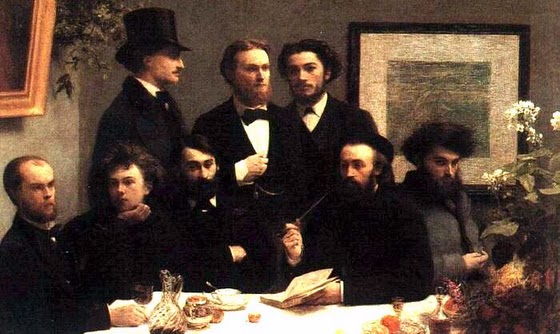
Born this day (2nd from left in the below painting, Verlaine is far left)

Arthur Rimbaud

Henri Fantin-Latour, By The Table, 1872


Home | Link
Tuesday | 20 October 2015 | 04:36 PM

Nirvana by Bukowski

not much chance,
completely cut loose from
purpose,
he was a young man
riding a bus
through North Carolina
on the way to somewhere
and it began to snow
and the bus stopped
at a little cafe
in the hills
and the passengers
entered.
he sat at the counter
with the others,
he ordered and the
food arived.
the meal was
particularly
good
and the
coffee.
the waitress was
unlike the women
he had
known.
she was unaffected,
there was a natural
humor which came
from her.
the fry cook said
crazy things.
the dishwasher.
in back,
laughed, a good
clean
pleasant
laugh.
the young man watched
the snow through the
windows.
he wanted to stay
in that cafe
forever.
the curious feeling
swam through him
that everything
was
beautiful
there,
that it would always
stay beautiful
there.
then the bus driver
told the passengers
that it was time
to board.
the young man
thought, I’ll just sit
here, I’ll just stay
here.
but then
he rose and followed
the others into the
bus.
he found his seat
and looked at the cafe
through the bus
window.
then the bus moved
off, down a curve,
downward, out of
the hills.
the young man
looked straight
foreward.
he heard the other
passengers
speaking
of other things,
or they were
reading
or
attempting to
sleep.
they had not
noticed
the
magic.
the young man
put his head to
one side,
closed his
eyes,
pretended to
sleep.
there was nothing
else to do-
just to listen to the
sound of the
engine,
the sound of the
tires
in the
snow.


Home | Link
Friday | 9 October 2015 | 06:14 PM

Born this day

The Hollow Men by T. S. Eliot

Mistah Kurtz—he dead.

      A penny for the Old Guy

      I

We are the hollow men
We are the stuffed men
Leaning together
Headpiece filled with straw. Alas!
Our dried voices, when
We whisper together
Are quiet and meaningless
As wind in dry grass
Or rats’ feet over broken glass
In our dry cellar

Shape without form, shade without colour,
Paralysed force, gesture without motion;

Those who have crossed
With direct eyes, to death’s other Kingdom
Remember us—if at all—not as lost
Violent souls, but only
As the hollow men
The stuffed men.

      II

Eyes I dare not meet in dreams
In death’s dream kingdom
These do not appear:
There, the eyes are
Sunlight on a broken column
There, is a tree swinging
And voices are
In the wind’s singing
More distant and more solemn
Than a fading star.

Let me be no nearer
In death’s dream kingdom
Let me also wear
Such deliberate disguises
Rat’s coat, crowskin, crossed staves
In a field
Behaving as the wind behaves
No nearer—

Not that final meeting
In the twilight kingdom

      III

This is the dead land
This is cactus land
Here the stone images
Are raised, here they receive
The supplication of a dead man’s hand
Under the twinkle of a fading star.

Is it like this
In death’s other kingdom
Waking alone
At the hour when we are
Trembling with tenderness
Lips that would kiss
Form prayers to broken stone.

      IV

The eyes are not here
There are no eyes here
In this valley of dying stars
In this hollow valley
This broken jaw of our lost kingdoms

In this last of meeting places
We grope together
And avoid speech
Gathered on this beach of the tumid river

Sightless, unless
The eyes reappear
As the perpetual star
Multifoliate rose
Of death’s twilight kingdom
The hope only
Of empty men.

      V

Here we go round the prickly pear
Prickly pear prickly pear
Here we go round the prickly pear
At five o’clock in the morning.

Between the idea
And the reality
Between the motion
And the act
Falls the Shadow
            For Thine is the Kingdom

Between the conception
And the creation
Between the emotion
And the response
Falls the Shadow
            Life is very long

Between the desire
And the spasm
Between the potency
And the existence
Between the essence
And the descent
Falls the Shadow
            For Thine is the Kingdom

For Thine is
Life is
For Thine is the

This is the way the world ends
Not with a bang but a whimper.


Home | Link
Saturday | 26 September 2015 | 09:23 PM

The Flower Lover by Bukowski

in the Valkerie Mountains
among the strutting peacocks
I found a flower
as large as my
head
and when I reached in to smell
it

I lost an ear lobe
part of my nose
one eye
and half a pack of
cigarettes.

I came back
the next day
to hack the damned thing
down
but found it so
beautiful I
killed a
peacock
instead.


Home | Link
Friday | 31 July 2015 | 10:11 AM

September 1, 1939 by W. H. Auden

I sit in one of the dives
On Fifty-second Street
Uncertain and afraid
As the clever hopes expire
Of a low dishonest decade:
Waves of anger and fear
Circulate over the bright 
And darkened lands of the earth,
Obsessing our private lives;
The unmentionable odour of death
Offends the September night.

Accurate scholarship can 
Unearth the whole offence
From Luther until now
That has driven a culture mad,
Find what occurred at Linz,
What huge imago made
A psychopathic god:
I and the public know
What all schoolchildren learn,
Those to whom evil is done
Do evil in return. 

Exiled Thucydides knew
All that a speech can say
About Democracy,
And what dictators do,
The elderly rubbish they talk
To an apathetic grave;
Analysed all in his book,
The enlightenment driven away,
The habit-forming pain,
Mismanagement and grief:
We must suffer them all again.

Into this neutral air
Where blind skyscrapers use
Their full height to proclaim
The strength of Collective Man,
Each language pours its vain
Competitive excuse:
But who can live for long
In an euphoric dream;
Out of the mirror they stare,
Imperialism’s face
And the international wrong.

Faces along the bar
Cling to their average day:
The lights must never go out,
The music must always play,
All the conventions conspire 
To make this fort assume
The furniture of home;
Lest we should see where we are,
Lost in a haunted wood,
Children afraid of the night
Who have never been happy or good.

The windiest militant trash
Important Persons shout
Is not so crude as our wish:
What mad Nijinsky wrote
About Diaghilev
Is true of the normal heart;
For the error bred in the bone
Of each woman and each man
Craves what it cannot have,
Not universal love
But to be loved alone.

From the conservative dark
Into the ethical life
The dense commuters come,
Repeating their morning vow;
“I will be true to the wife,
I’ll concentrate more on my work,"
And helpless governors wake
To resume their compulsory game:
Who can release them now,
Who can reach the deaf,
Who can speak for the dumb?

All I have is a voice
To undo the folded lie,
The romantic lie in the brain
Of the sensual man-in-the-street
And the lie of Authority
Whose buildings grope the sky:
There is no such thing as the State
And no one exists alone;
Hunger allows no choice
To the citizen or the police;
We must love one another or die.

Defenceless under the night
Our world in stupor lies;
Yet, dotted everywhere,
Ironic points of light
Flash out wherever the Just
Exchange their messages:
May I, composed like them
Of Eros and of dust,
Beleaguered by the same
Negation and despair,
Show an affirming flame.


Home | Link
Sunday | 19 July 2015 | 05:21 PM

How Is Your Heart? by Bukowski

during my worst times
on the park benches
in the jails
or living with
whores
I always had this certain
contentment-
I wouldn't call it
happiness-
it was more of an inner
balance 
that settled for
whatever was occuring
and it helped in the
factories
and when relationships 
went wrong
with the 
girls. 
it helped 
through the
wars and the
hangovers
the backalley fights
the 
hospitals. 
to awaken in a cheap room
in a strange city and
pull up the shade-
this was the craziest kind of
contentment

and to walk across the floor
to an old dresser with a 
cracked mirror- 
see myself, ugly,
grinning at it all. 
what matters most is
how well you 
walk through the
fire.


Home | Link
Tuesday | 14 July 2015 | 10:44 AM

RIP André Brink

A Dry White Season by Mongane Wally Serote

It is a dry white season
dark leaves don’t last, their brief lives dry out
and with a broken heart they
dive down gently headed for the earth
not even bleeding.
it is a dry white season brother, 
only the trees know the pain as they still stand erect
dry like steel, their branches dry like wire,
indeed, it is a dry white season 
but seasons come to pass


Home | Link
Saturday | 7 February 2015 | 01:04 PM

IN CAMOGLI by Dan Fante

It looks like the same ocean 
but this is Italy - not L.A. 

Sitting at sunset in a two-hundred-dollar-a day hotel 
by the sea 

All expenses paid - no limit on the drinks 

Reading my shit in rooms full of Fante fanatics 
where - sadly - everybody now speaks perfect coca-cola and wears Levis
and 
looks like Tom Cruise without the big teeth 

On this trip I've been a fine success at impersonating a writer 
my poetry - remarkably - even sounds like me 
before I lost my muse 
and became a hopeless moron-hasbeen-talentless-retard 
fuck 
with a freight train roaring through my mind 
chasing a ridiculous lost idea of literary perfection 

But I warn you 
I'm like a dented 1985 Ford 
with a busted radiator, 
a cracked windshield, 
and 3 bald tires 
speeding down the autobahn 

Don't try to diss me or pass me or call my bluff 
'cause - see 
when I'm cornered 
I can write like a gin-pissing-raw-meat-dual-carburator-V8-son-of-a-bitch 

even in Italy


Home | Link
Saturday | 18 October 2014 | 02:50 AM

Self-pity by D. H. Lawrence

I never saw a wild thing 
sorry for itself. 
A small bird will drop frozen dead from a bough
without ever having felt sorry for itself.


Home | Link
Friday | 19 September 2014 | 10:51 AM

A Brief for the Defense by Jack Gilbert

Sorrow everywhere. Slaughter everywhere. If babies
are not starving someplace, they are starving
somewhere else. With flies in their nostrils.
But we enjoy our lives because that's what God wants.
Otherwise the mornings before summer dawn would not
be made so fine. The Bengal tiger would not
be fashioned so miraculously well. The poor women
at the fountain are laughing together between
the suffering they have known and the awfulness
in their future, smiling and laughing while somebody
in the village is very sick. There is laughter
every day in the terrible streets of Calcutta,
and the women laugh in the cages of Bombay.
If we deny our happiness, resist our satisfaction,
we lessen the importance of their deprivation.
We must risk delight. We can do without pleasure,
but not delight. Not enjoyment. We must have
the stubbornness to accept our gladness in the ruthless
furnace of this world. To make injustice the only
measure of our attention is to praise the Devil.
If the locomotive of the Lord runs us down,
we should give thanks that the end had magnitude.
We must admit there will be music despite everything.
We stand at the prow again of a small ship
anchored late at night in the tiny port
looking over to the sleeping island: the waterfront
is three shuttered cafés and one naked light burning.
To hear the faint sound of oars in the silence as a rowboat
comes slowly out and then goes back is truly worth
all the years of sorrow that are to come.


Home | Link
Thursday | 28 August 2014 | 04:16 PM

Love Will Tear Us Apart by Ian Curtis

When routine bites hard,
And ambitions are low,
And resentment rides high,
But emotions won't grow,
And we're changing our ways,
Taking different roads.

Then love, love will tear us apart again.
Love, love will tear us apart again.

Why is the bedroom so cold?
You've turned away on your side.
Is my timing that flawed?
Our respect runs so dry.
Yet there's still this appeal
That we've kept through our lives.

But love, love will tear us apart again.
Love, love will tear us apart again.

You cry out in your sleep,
All my failings exposed.
And there's a taste in my mouth,
As desperation takes hold.
Just that something so good
Just can't function no more.

But love, love will tear us apart again.
Love, love will tear us apart again.


Home | Link
Wednesday | 18 June 2014 | 03:54 PM

First | Previous | Next | Last

Page 8 of 12